About 5-Amino-1MQ
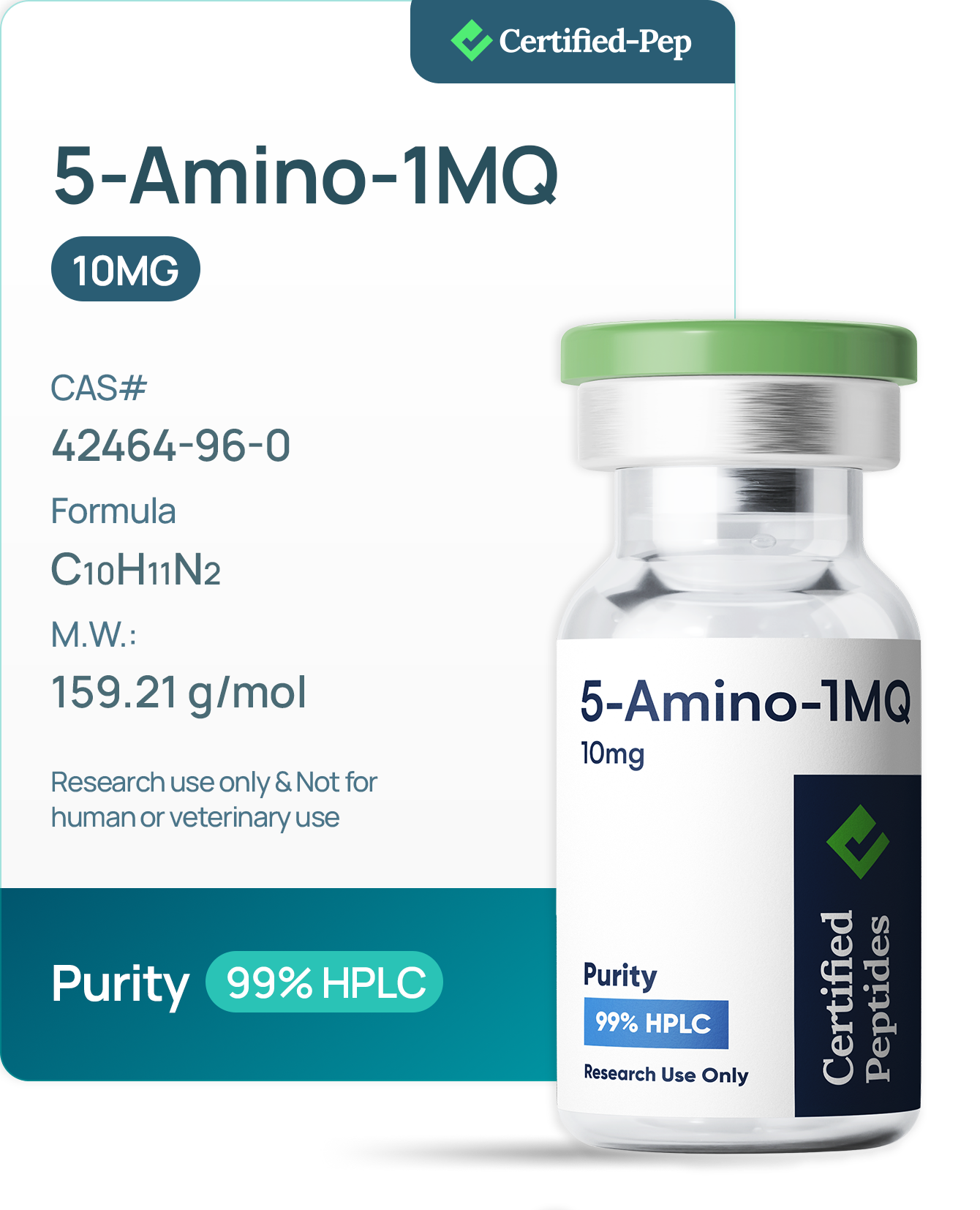
5-Amino-1MQ is a methylated quinoline that inhibits nicotinamide N-methyltransferase (NNMT). Preclinical studies show effects on adipose tissue, muscle mass, and metabolic markers. Limited human data.
Longevity
NNMT Inhibitor
A small-molecule NNMT inhibitor studied for metabolic health and longevity. Not a peptide; commonly stocked in peptide vendor catalogs.
5-Amino-1MQ is a methylated quinoline that inhibits nicotinamide N-methyltransferase (NNMT). Preclinical studies show effects on adipose tissue, muscle mass, and metabolic markers. Limited human data.
Where to buy
Some links on this page are affiliate links. We may earn a commission when you purchase through them, at no extra cost to you.
 Best $/mg


 Atomik LabzTested
LIQUID – 5-Amino-1MQ/NADH (50mg/40mg per ml) (20ml)
$99.00
$1.98/mg · 50mg

 Atomik LabzTested
5-Amino-1MQ – 50mg (Lyophilized)
$129.00
$2.58/mg · 50mg

 Solution PeptidesTested
5-Amino-1MQ – 50mg (Lyophilized)
$129.00
$2.58/mg · 50mg
 Atomik LabzTested
CAPSULES – 5-Amino-1MQ 50mg x 90 Capsules
$169.00
$3.38/mg · 50mg
 Solution PeptidesTested
CAPSULES – 5-Amino-1MQ 50mg x 90 Capsules
$169.00
$3.38/mg · 50mg


 Solution PeptidesTested
LIQUID – 5-Amino-1MQ/NADH (20ml)
$99.00
— ·
Evidence level
Preclinical only
A small-molecule inhibitor of nicotinamide N-methyltransferase (NNMT). Studied preclinically for fat-loss and lean-mass preservation by preserving cellular NAD+ and SAM. Not technically a peptide, but routinely stocked in peptide catalogs.
Mechanism
Inhibits NNMT to preserve cellular NAD+ and SAM pools.
Researched benefits
Adipocyte size reduction
In diet-induced obese mice, oral 5-Amino-1MQ reduced white adipose tissue mass and adipocyte diameter without changing food intake. The effect is attributed to NNMT inhibition releasing the brake on SAM-dependent methylation flux in fat.
Lean mass preservation
Aged mouse muscle shows elevated NNMT; pharmacological inhibition restored myogenic capacity and grip strength in preclinical models. Suggested as an exercise-adjacent intervention for sarcopenia, though human studies have not been published.
NAD+ and SAM sparing
NNMT consumes SAM and produces 1-methylnicotinamide from nicotinamide, draining methyl donors. Inhibition raises intracellular NAD+ precursors and SAM, with downstream effects on histone methylation and energy metabolism.
Risks & cautions
No human efficacy or safety trials
All efficacy data is rodent. Human pharmacokinetics, chronic-dosing safety, and effective dose ranges are extrapolated. Adverse events at typical research doses are not characterized.
Methylation pathway perturbation
Raising SAM globally has unpredictable epigenetic and neurochemical effects (catecholamine methylation, homocysteine balance). The long-term consequences of sustained NNMT inhibition in humans are unknown.
Off-target effects unclear
5-Amino-1MQ was developed as a research tool; selectivity in humans across the broader methyltransferase family has not been thoroughly mapped.
Dosing
Commonly reported as 50–150 mg orally once daily, taken with food. Cycled 8–12 weeks on, 4 weeks off in practitioner protocols.
Vial sizes
100mg
Half-life
~6 hours
Route
oral
Oral bioavailability is reasonable in mice. Take with food to reduce GI upset. No reconstitution required for the freebase capsule form.
Contraindications
In depth
5-Amino-1-methylquinolinium (5-Amino-1MQ) is a small-molecule inhibitor of nicotinamide N-methyltransferase, an enzyme that quietly drains the cell's methyl-donor pool. NNMT activity is upregulated in white adipose tissue of obese humans and in aged muscle, and the prevailing hypothesis is that this drain is a node in metabolic dysfunction.
It is not a peptide in the chemical sense — it's a methylated quinoline — but it has been adopted into the "research peptide" supply chain because the audience overlaps with longevity and body-composition users.
NNMT catalyzes the transfer of a methyl group from S-adenosylmethionine (SAM) to nicotinamide, producing 1-methylnicotinamide (1-MNA) and S-adenosylhomocysteine. By doing so it:
Inhibiting NNMT therefore preserves both NAD+ and SAM. The downstream consequences include:
There is essentially none. Search of clinicaltrials.gov returns no completed trials of 5-Amino-1MQ. Human safety, efficacy, and pharmacokinetics are inferred. Practitioner reports are anecdotal.
Several rodent studies converge on the same story:
The signal is consistent across labs at the rodent level. Translation is the question.
Frequently combined with:
Avoid stacking with high-dose nicotinamide if the goal is to maximize NAD+, since unblocked NNMT will methylate it away — but the inhibitor is doing exactly that work, so this is more a theoretical issue than a clinical one.
References


