About AOD-9604
AOD-9604 is the 176-191 fragment of human growth hormone studied for its ability to stimulate lipolysis and fat oxidation without affecting IGF-1 or growth. Most evidence is preclinical with mixed human results.
Weight Loss
HGH Fragment 176-191
A 16-amino-acid fragment of growth hormone studied for fat oxidation without GH growth effects.
AOD-9604 is the 176-191 fragment of human growth hormone studied for its ability to stimulate lipolysis and fat oxidation without affecting IGF-1 or growth. Most evidence is preclinical with mixed human results.
Where to buy
Some links on this page are affiliate links. We may earn a commission when you purchase through them, at no extra cost to you.
 Best $/mg


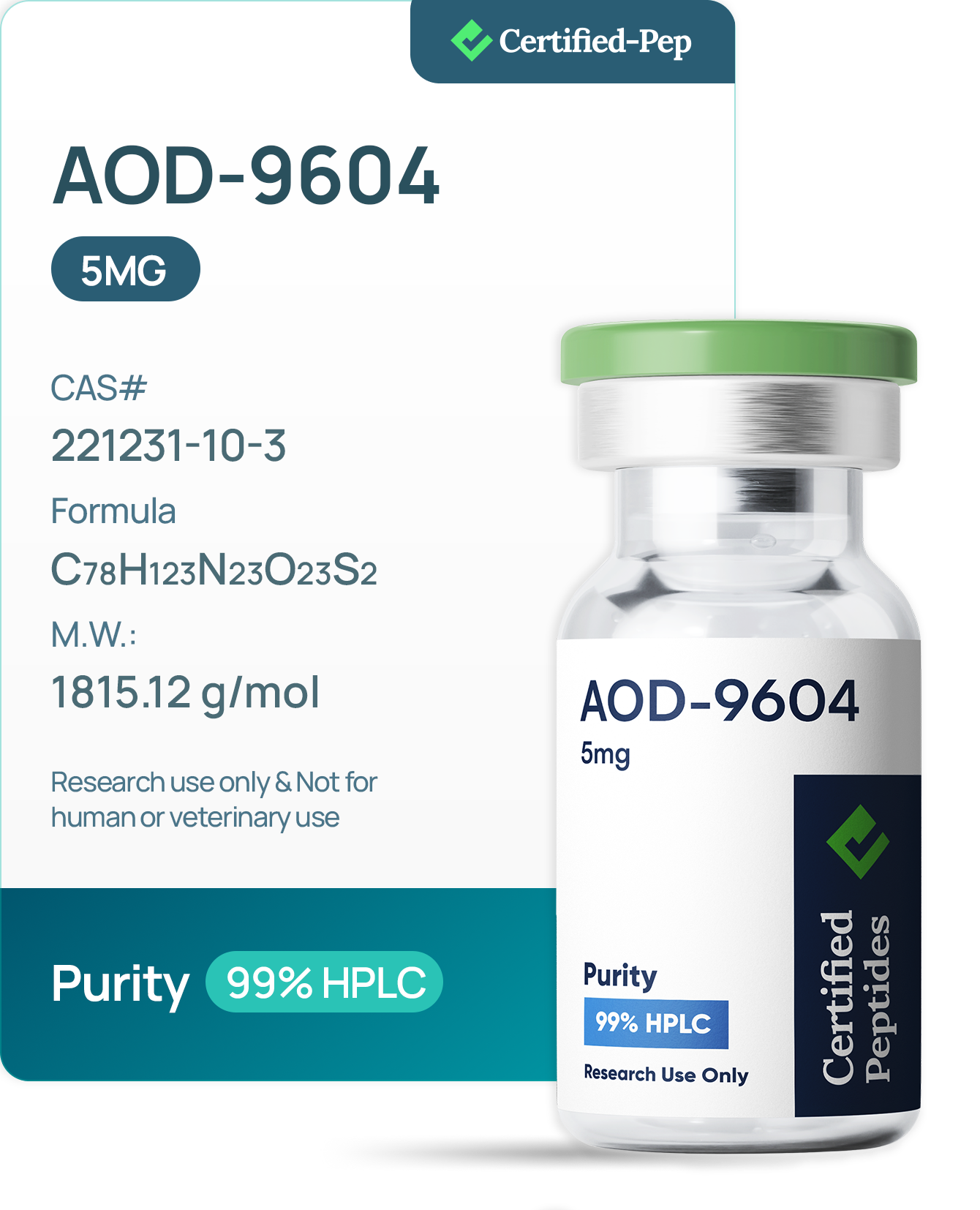


Evidence level
Early human studies
A 16-amino-acid C-terminal fragment of human growth hormone (residues 176–191) studied for fat-mobilizing activity without the growth-promoting effects of full-length GH. Human efficacy data is mixed.
Mechanism
Activates beta-3 adrenergic receptors and stimulates lipolysis.
Researched benefits
Targeted lipolysis (preclinical)
Rodent obesity models show increased fatty-acid release from adipose tissue and modest weight loss versus vehicle. The fragment retains the lipolytic domain of GH while lacking the growth-promoting regions.
No measurable IGF-1 elevation
Unlike intact GH, AOD-9604 does not bind GH receptors with high affinity and does not measurably raise IGF-1 in published human trials — this is the original design rationale.
Possible cartilage / joint signal
Smaller exploratory studies have examined AOD-9604 as an adjunct in osteoarthritis and cartilage repair models; results are early-stage and not definitive.
Risks & cautions
Weak human efficacy
A 12-week phase IIb obesity trial in roughly 500 adults did not show clinically meaningful weight loss versus placebo. The peptide was well tolerated but underperformed expectations from rodent work.
Regulatory ambiguity
AOD-9604 was investigated as a pharmaceutical (Metabolic Pharmaceuticals) and later marketed as a cosmetic/nutraceutical ingredient. It is not an approved drug for weight loss in any major jurisdiction.
Injection-site reactions
Subcutaneous administration carries the usual risks: transient erythema, mild bruising, and lipohypertrophy with repeated use of the same site.
Unknown long-term safety
Trials longer than a few months are sparse. Chronic effects on adipose biology, insulin signaling, and other GH-fragment receptor interactions are not well characterized.
Dosing
250–500 mcg subcutaneously once daily, typically in the morning on an empty stomach, in 8–12 week blocks.
Vial sizes
2mg / 5mg
Half-life
Short
Route
subcutaneous
Reconstitute with bacteriostatic water. The lipolytic mechanism is thought to be most relevant in a fasted state, which is the basis for AM-fasted dosing. Half-life is short (under an hour) so daily dosing is standard.
Contraindications
In depth
AOD-9604 ("Anti-Obesity Drug 9604") is a synthetic peptide corresponding to the C-terminal residues 176–191 of human growth hormone, with a tyrosine added to the N-terminus to improve stability. It was developed at Monash University in Australia in the 1990s and licensed to Metabolic Pharmaceuticals as an oral or injectable obesity therapeutic.
The original hypothesis was that GH's lipolytic activity could be separated from its growth-promoting effects by isolating the relevant C-terminal fragment. Animal work supported this: the fragment mobilized fat without raising IGF-1 or causing the insulin resistance characteristic of full-dose GH.
The proposed mechanism is enhancement of β3-adrenergic-receptor–mediated lipolysis in adipocytes, leading to increased release of free fatty acids and stimulation of fat oxidation. AOD-9604 does not bind the GH receptor with appreciable affinity at therapeutic doses, which is consistent with the absence of measurable IGF-1 changes in human studies.
Some mechanistic details remain unresolved. The peptide is small, the in vivo receptor target is not definitively a single receptor, and downstream signaling has been characterized mostly in cultured adipocytes and rodent tissue.
Human evidence is limited and mostly negative for weight loss:
After the phase IIb result, Metabolic Pharmaceuticals pivoted away from obesity. The peptide has since been distributed as a research compound and used off-label in body-composition contexts despite the underwhelming trial data.
Rodent data is more consistent than human data:
The translation gap is the central open question — rodent adipose biology differs meaningfully from human adipose biology, particularly in β3-adrenergic-receptor density and function.
In practice, AOD-9604 is sometimes stacked with:
Stacking does not rescue the underlying efficacy issue from the phase IIb trial. If the goal is meaningful fat loss, GLP-1/GIP agonists have a much stronger evidence base.
References


