Background
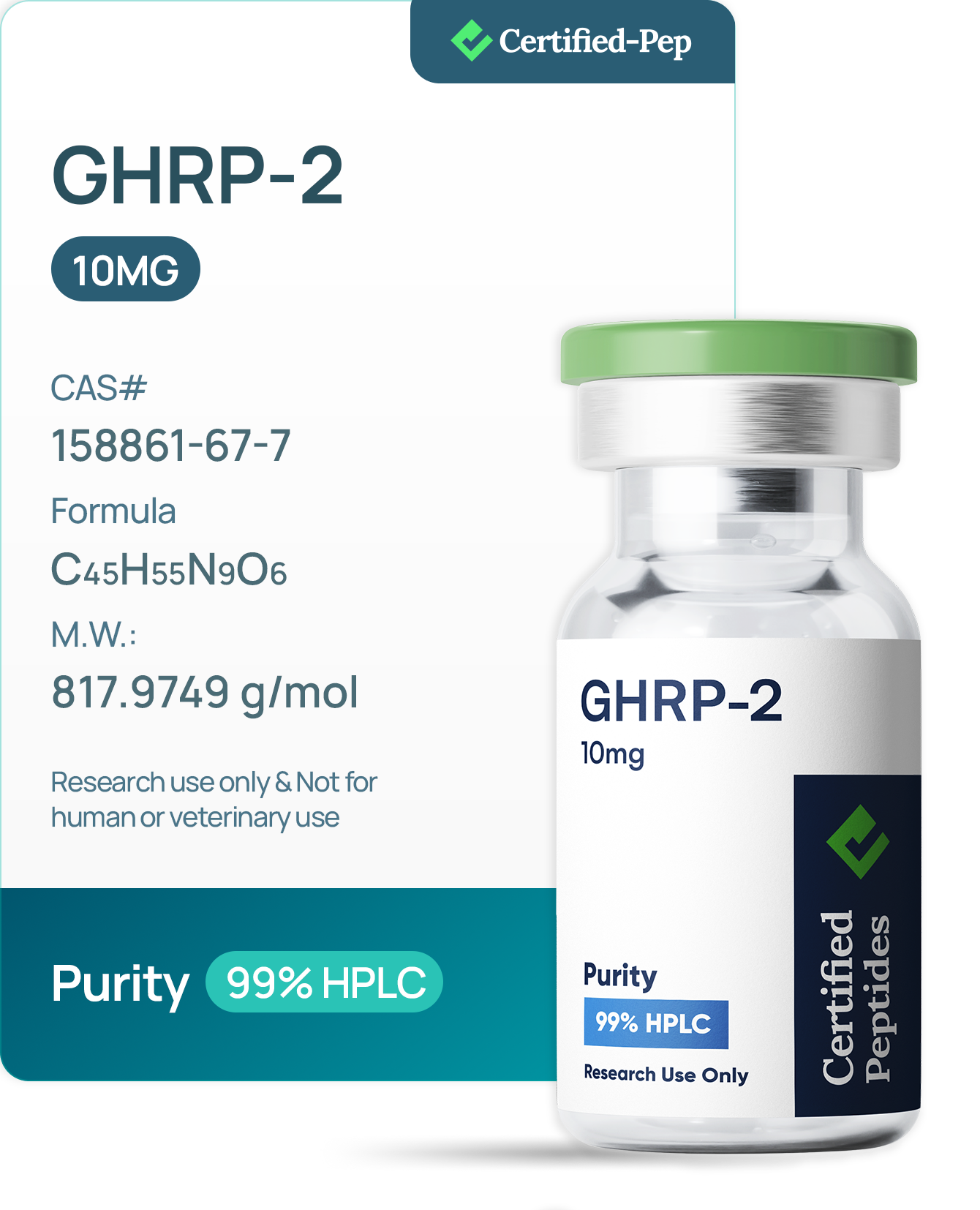
GHRP-2 (KP-102, pralmorelin) is a synthetic hexapeptide developed by Cyril Bowers' group in the 1990s as a second-generation refinement of GHRP-6. It was investigated as a diagnostic agent for GH deficiency and as a potential treatment for cachexia and GH insufficiency in elderly patients. It is approved as a diagnostic reagent in Japan; it is not approved as a therapeutic in the US or EU.
It belongs to the ghrelin mimetic family alongside GHRP-6, hexarelin, ipamorelin, and the small-molecule MK-677 (ibutamoren). Among these it is notable for strong potency and equally strong appetite stimulation.
Mechanism in depth
GHRP-2 is a ghrelin receptor (GHS-R1a) agonist. Activation of this receptor on pituitary somatotrophs:
- Triggers GH release through a Ca2+ and PLC-mediated pathway distinct from GHRH's cAMP-mediated pathway.
- Suppresses somatostatin tone at the hypothalamic level, removing a brake on subsequent GH pulses.
- Stimulates hypothalamic NPY/AgRP neurons, producing strong hunger.
- Modestly raises ACTH and prolactin via off-target pituitary effects.
The synergy with GHRH analogs is real and reproducible: blocking somatostatin (GHRP) while simultaneously stimulating GHRH receptors produces a GH pulse 5–10× higher than either alone.
Human evidence
Well-characterized for short-term GH-releasing efficacy:
- Multiple healthy-volunteer studies confirm reliable GH pulse generation.
- Open-label cohorts in GH-deficient adults report IGF-1 normalization.
- A small chronic-dosing study (Bowers 2004) showed sustained IGF-1 elevation with continuous infusion.
- Appetite stimulation has been demonstrated in a controlled meal-test (Laferrère 2005).
There are no long-term outcome trials on body composition, longevity, or disease-specific endpoints.
Animal evidence
Extensive in rats, dogs, and pigs. The dose-response is well-characterized and consistent across species. Long-term rat studies showed sustained IGF-1 elevation without obvious tumor or organ toxicity, but these were not lifetime-duration.
Stack synergy
GHRP-2 is almost always used in combination:
- CJC-1295 / sermorelin / tesamorelin — the GHRH side of the pulse-generating duo. Standard practice.
- Ipamorelin — sometimes alternated with GHRP-2 to balance potency against cortisol/prolactin profile (ipamorelin is cleaner; GHRP-2 is stronger).
- MK-677 — overlapping mechanism; using both is redundant and amplifies side effects.
Avoid stacking with anything that raises cortisol independently (yohimbine at high doses, sleep restriction, severe caloric deficit) — the additive HPA load is unfavorable.
Open questions
- Is the appetite stimulation manageable in body-composition use cases, or does it always dominate?
- Does chronic GHRP-2 produce the same long-term IGF-1 cancer-risk profile as exogenous rhGH?
- What is the optimal dosing interval to maximize GH pulse amplitude while minimizing receptor desensitization?
- Is the cortisol/prolactin elevation clinically meaningful at typical doses, or only at supraphysiologic ranges?