Skip to content
Save at BioLongevity Labs with code EVERYDAY•Save at S1 Research with code everydaypeptide•Save at Alpha Peptides with code EVERYDAY•Save at Ion Peptide with code EVERYDAY•Save at Solution Peptides with code EVERYDAY15•Save at Atomik Labz with code EVERYDAY25•Save at Next Gen Peps with code EVERYDAY•
EVERYDAYPEPTIDES
  • Peptides
  • Vendors
  1. Home
  2. Peptides
  3. GLP2-T

Other

GLP2-T

GLP2-T is a research-use product carried by vendors we track. For research use only; an editorial review is pending.

PreclinicalResearch use only

About GLP2-T

GLP2-T is offered by one or more vendors we track. We have not yet written a detailed editorial summary for this compound. The offerings below reflect what vendors currently carry. For research use only — verify dosing, handling, and safety against primary sources.

Category
Other
Typical dose
--
Vial sizes
--
Half-life
--
Administration
--
Goals

Where to buy

Vendor offerings

Some links on this page are affiliate links. We may earn a commission when you purchase through them, at no extra cost to you.

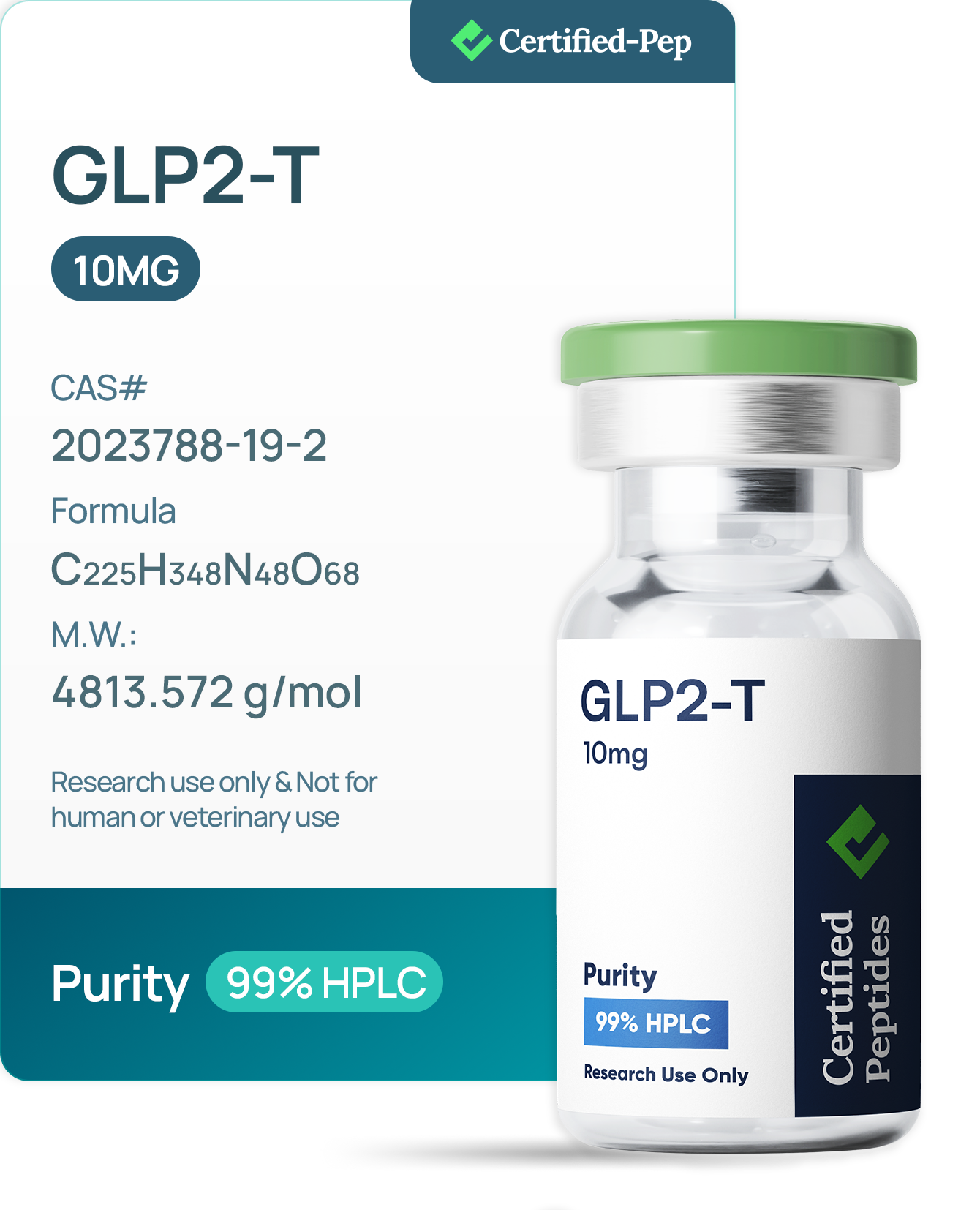
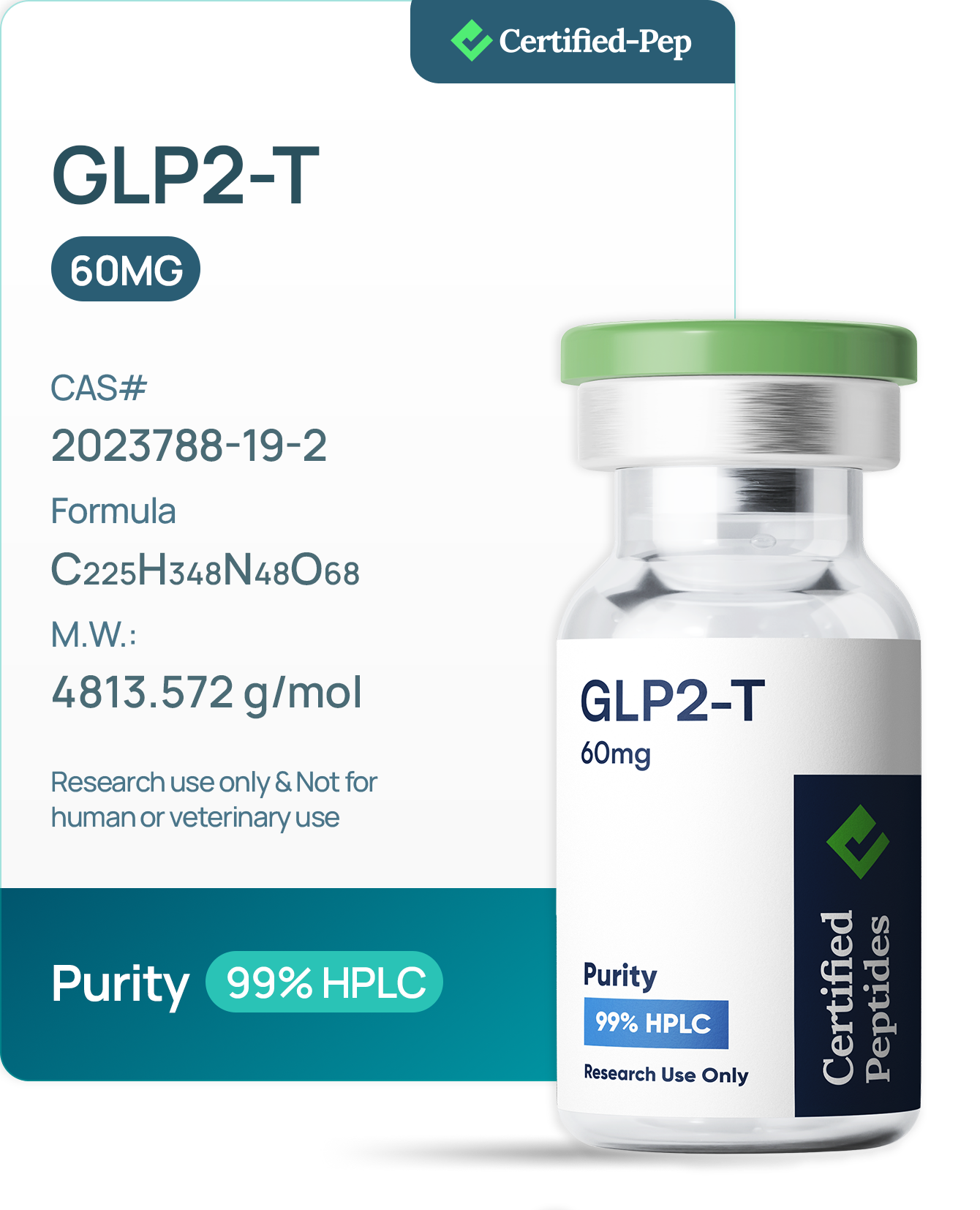
  • GLP2-T 60MG from Certified PeptidesBest $/mg
    Certified PeptidesTested

    GLP2-T 60MG

    $240.00

    $4.00/mg · 60mg

    Shop on Certified Peptides
  • GLP2-T 30MG from Certified Peptides
    Certified PeptidesTested

    GLP2-T 30MG

    $140.00

    $4.67/mg · 30mg

    Shop on Certified Peptides
  • GLP2-T 10MG from Certified Peptides
    Certified PeptidesTested

    GLP2-T 10MG

    $120.00

    $12.00/mg · 10mg

    Shop on Certified Peptides

Evidence level

Preclinical only

A research-market designation that typically refers to GLP-2 (glucagon-like peptide 2) or a stabilized/tagged GLP-2 analog. The clinically validated drug in this class is teduglutide (Gattex), approved for short bowel syndrome.

Mechanism

Mechanism not yet documented.

Researched benefits

  • Intestinal mucosal growth

    GLP-2 is the most potent known stimulus for small intestinal villus growth and crypt-cell proliferation. The clinical proof point is teduglutide, which reduced parenteral nutrition dependence in short bowel syndrome trials (n=86 in pivotal STEPS trial).

  • Barrier function support

    Strengthens tight junctions, reduces intestinal permeability ('leaky gut'), and reduces translocation of bacterial products in animal and human models. Practical relevance to non-SBS populations is uncertain.

  • Possible utility in intestinal injury

    Animal models of chemotherapy- or radiation-induced enteritis show reduced damage with GLP-2 administration. Human data outside SBS is limited.

Risks & cautions

  • high

    Intestinal neoplasia risk

    GLP-2 drives crypt-cell proliferation. Both teduglutide labeling and preclinical data flag a theoretical (and observed at the polyp level) risk of intestinal and colorectal neoplasia with sustained use. Baseline and periodic colonoscopy is part of teduglutide's standard monitoring.

  • moderate

    Gallbladder and biliary effects

    Teduglutide trials reported cholecystitis, cholelithiasis, and biliary dilation in a non-trivial minority. Mechanism is incompletely understood. Gallbladder imaging is part of standard monitoring.

  • moderate

    Pancreatic concerns

    Pancreatitis has been reported with teduglutide. The signal is real but uncommon.

  • moderate

    Fluid overload

    Restoration of intestinal absorption can rapidly change fluid balance in patients previously on parenteral nutrition. Less relevant for non-SBS users, but worth noting.

  • high

    Identity ambiguity

    'GLP2-T' is not a single defined molecule in published literature. Different vendors may sell native GLP-2 (33 aa), teduglutide-like analogs, or research conjugates. Sequence and purity matter enormously.

Dosing

Teduglutide reference: 0.05 mg/kg subcutaneously once daily. Research-market GLP-2 protocols vary widely and are not standardized.

Conservative
100–250 mcg daily (research market, not standardized)
Standard
Teduglutide 0.05 mg/kg/day (≈3.5 mg for 70 kg)
Aggressive
Higher doses not supported by data

Vial sizes

--

Half-life

--

Route

--

Native GLP-2 has a half-life of ~7 minutes (cleaved by DPP-IV); teduglutide is DPP-IV-resistant and has a half-life of ~2 hours, supporting once-daily dosing. If a vendor 'GLP2-T' is unstabilized native GLP-2, daily dosing is unlikely to produce sustained effect.

Contraindications

  • Active GI malignancy (absolute)
  • History of gastrointestinal cancers including hepatobiliary and pancreatic (absolute)
  • Active intestinal obstruction
  • Pregnancy or breastfeeding
  • Untreated polyps — colonoscopy recommended before initiating analogous to teduglutide protocol

In depth

Background

GLP-2 is a 33-amino-acid peptide hormone released by intestinal L-cells in parallel with GLP-1 from the same proglucagon precursor. Its physiologic role is to coordinate the post-meal intestinal growth response — villus elongation, increased nutrient absorption surface, and barrier reinforcement.

"GLP2-T" is a designation seen on some research-peptide vendor lists. It is not a standardized term in the published pharmacological literature. The likely interpretations are:

  1. Native GLP-2 (33 aa, rapidly cleared by DPP-IV).
  2. Teduglutide — a DPP-IV-resistant analog with a single alanine→glycine substitution at position 2. This is the approved drug Gattex.
  3. A vendor-specific tagged or conjugated analog with undisclosed structure.

Sequence ambiguity is a real safety concern. Pharmacology described below refers to GLP-2 and teduglutide; whether a specific vendor product behaves the same depends on what it actually is.

Mechanism in depth

GLP-2 signals through the GLP-2 receptor (GLP-2R), a class B GPCR expressed primarily on enteric neurons and subepithelial myofibroblasts (not on enterocytes directly). Downstream effects include:

  1. Crypt cell proliferation. IGF-1, EGF, and KGF release from subepithelial cells drives epithelial expansion.
  2. Antiapoptotic signaling. Reduces enterocyte apoptosis under stress.
  3. Tight-junction reinforcement. Increases expression of claudin-3, ZO-1; reduces permeability.
  4. Mesenteric blood flow increase. Localized vasodilation contributes to mucosal nutrient absorption.

The same proliferative signal that produces clinical benefit in short bowel syndrome is the mechanistic basis for the cancer concern.

Human evidence

The validated dataset is for teduglutide:

  • Jeppesen 2011 (STEPS, n=86, 24 weeks) — primary endpoint of ≥20% reduction in parenteral nutrition volume met by 63% of teduglutide patients vs 30% placebo in adult SBS.
  • Pediatric extensions demonstrated similar effects in children with SBS.
  • Long-term registries have refined the safety signal: cholecystitis, pancreatitis, and intestinal polyps occur at meaningful rates.

Outside SBS, human data for GLP-2 is sparse — small trials in inflammatory bowel disease, chemotherapy-induced mucositis, and post-bariatric absorption have shown signals but not led to indications.

Animal evidence

Rodent models replicate intestinal growth, barrier repair, and protection against chemotherapy/radiation enteritis. The colon polyp signal is also reproducible in long-term rodent studies — this is not a hypothetical concern, it is observed in animal carcinogenicity work.

Stack synergy

In SBS clinical practice teduglutide is layered onto parenteral nutrition with gradual taper. In research/peptide markets it is sometimes stacked with:

  • BPC-157 — both promote GI healing via distinct mechanisms. Combination is anecdotal; no formal data.
  • GLP-1 agonists — share the proglucagon precursor but distinct receptors. No specific interaction signal but the proliferative concern of GLP-2 may compound any unrelated GI risk.

Avoid stacking with IGF-1 or aggressive GH protocols without thought — IGF-1 is part of the GLP-2 proliferative cascade; adding exogenous IGF-1 may amplify the same cancer concern.

Open questions

  • Is non-SBS use of GLP-2 (e.g., for general "gut health" or barrier support) supported by any clinical data? Effectively no — this is extrapolation from mechanism.
  • What is the actual cancer risk magnitude with chronic exposure in healthy users? Teduglutide registry data is informative but the SBS population has different baseline risk than typical research-peptide users.
  • What is the structure of vendor "GLP2-T" specifically? Without sequence confirmation, pharmacological inference is speculative.
  • Does intermittent / cyclic dosing meaningfully reduce the proliferative risk while preserving benefit? This is the obvious question but no rigorous data exists.
References

  1. 1.Jeppesen P.B. et al. — Randomised placebo-controlled trial of teduglutide in reducing parenteral nutrition and/or intravenous fluid requirements in short bowel syndrome (Gut, 2011)
  2. 2.Drucker D.J., Yusta B. — Physiology and pharmacology of the enteroendocrine hormone glucagon-like peptide-2 (Annual Review of Physiology, 2014)
  3. 3.Prescribing information — Gattex (teduglutide)

Everyday Peptides

Independent peptide guides and vendor comparison. Research-grade information for adult researchers.

Browse

  • All peptides
  • All vendors

About

  • About us
  • Contact

Legal

  • Affiliate disclosure
  • Privacy

(c) 2026 Everyday Peptides. Some links on this site are affiliate links. We may earn a commission when you purchase through them, at no extra cost to you.

All content is for educational purposes only and is not medical advice. Peptides discussed are for research use only.