Skip to content
Save at BioLongevity Labs with code EVERYDAY•Save at S1 Research with code everydaypeptide•Save at Alpha Peptides with code EVERYDAY•Save at Ion Peptide with code EVERYDAY•Save at Solution Peptides with code EVERYDAY15•Save at Atomik Labz with code EVERYDAY25•Save at Next Gen Peps with code EVERYDAY•
EVERYDAYPEPTIDES
  • Peptides
  • Vendors
  1. Home
  2. Peptides
  3. KISSPEPTIN10

Sexual Health

KISSPEPTIN10

KISSPEPTIN10 is a research-use product carried by vendors we track, grouped under Sexual Health. For research use only; an editorial review is pending.

PreclinicalResearch use only

About KISSPEPTIN10

KISSPEPTIN10 is offered by one or more vendors we track. We have not yet written a detailed editorial summary for this compound. The offerings below reflect what vendors currently carry. For research use only — verify dosing, handling, and safety against primary sources.

Category
Sexual Health
Typical dose
--
Vial sizes
--
Half-life
--
Administration
--
Goals
Sexual health

Where to buy

Vendor offerings

Some links on this page are affiliate links. We may earn a commission when you purchase through them, at no extra cost to you.

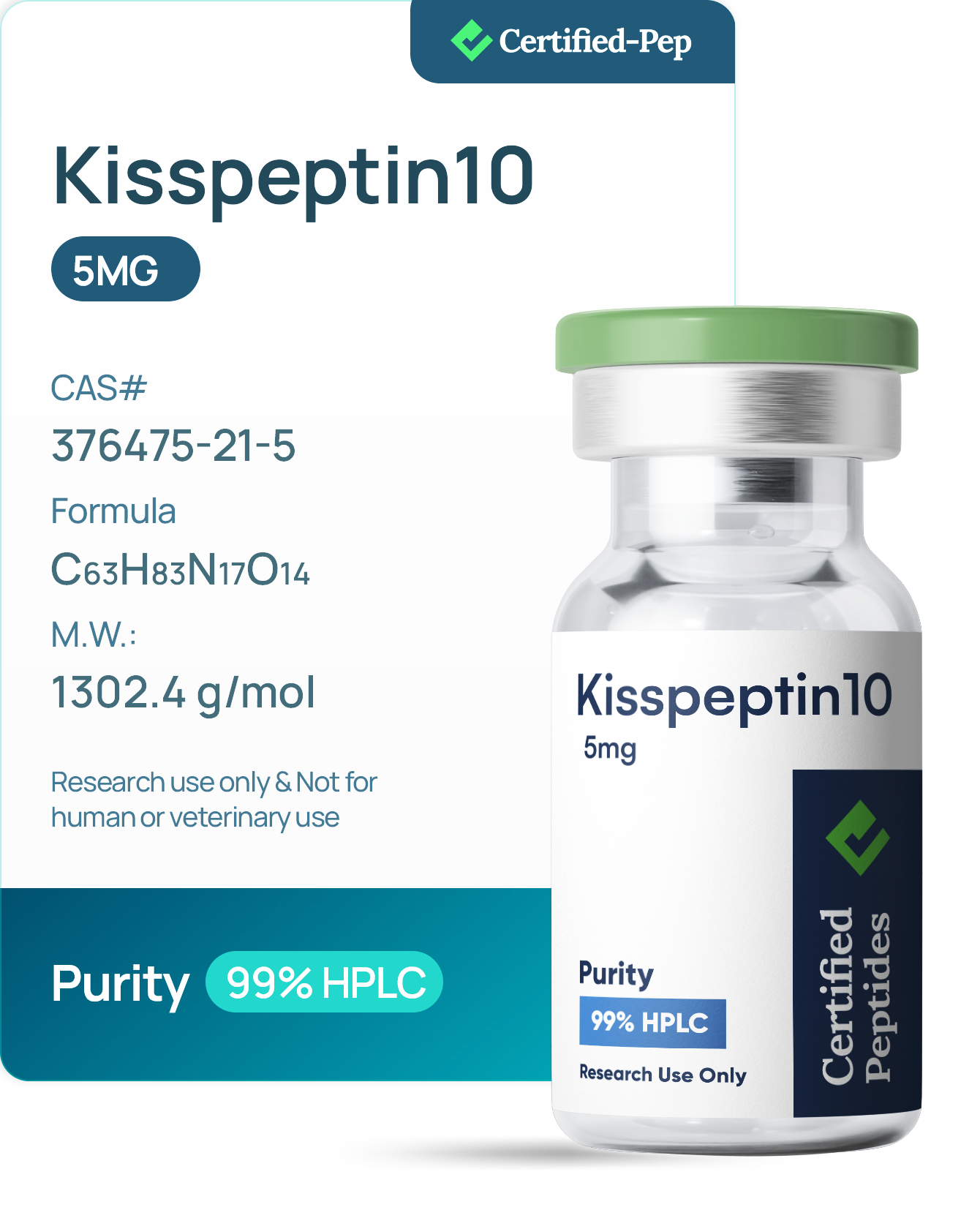
  • KISSPEPTIN10 5MG from Certified Peptides
    Certified PeptidesTested

    KISSPEPTIN10 5MG

    $52.00

    $10.40/mg · 5mg

    Shop on Certified Peptides

Evidence level

Preclinical only

A ten-amino-acid C-terminal fragment of the parent kisspeptin protein, retaining full biological activity at the KISS1R receptor. Studied for its role as a master regulator of the reproductive axis — triggering GnRH release upstream of LH/FSH. Used in research protocols for hypogonadism, ovulation induction, and exploration of reproductive endocrinology.

Mechanism

Mechanism not yet documented.

Researched benefits

  • Stimulation of the reproductive axis

    Kisspeptin-10 acts on KISS1R receptors in the hypothalamus, triggering GnRH release and downstream LH and FSH secretion from the pituitary. In men, this produces an acute rise in testosterone within hours; in women, it can trigger ovulation under appropriate cycle conditions.

  • Diagnostic and ovulation-induction use

    Kisspeptin-54 (the longer variant) has been studied in clinical trials as a safer alternative to hCG for triggering ovulation in IVF, with reduced risk of ovarian hyperstimulation syndrome (OHSS) — Jayasena et al. demonstrated successful oocyte maturation triggering with kisspeptin in a phase II trial.

  • Possible role in hypothalamic hypogonadism

    Patients with congenital GnRH deficiency due to KISS1R loss-of-function mutations validate kisspeptin's central role. Exogenous kisspeptin can elicit GnRH/LH response in some forms of hypothalamic hypogonadism.

  • Investigational role in sexual response

    Small human studies (Comninos et al.) have explored kisspeptin's effects on sexual and emotional brain processing using fMRI. Findings suggest enhanced limbic activity in response to sexual stimuli with kisspeptin infusion, but clinical implications remain exploratory.

Risks & cautions

  • moderate

    Limited safety data outside research settings

    Kisspeptin has been administered safely in clinical trial settings, but long-term out-of-clinic use is uncharacterized. The reproductive axis is a high-leverage target — sustained or supraphysiologic activation has theoretical risks.

  • moderate

    Reproductive axis activation

    By design, kisspeptin activates GnRH release. In women, this can disrupt cycle timing and trigger ovulation outside intended windows. In men with hypogonadism it is generally desirable but should be supervised.

  • moderate

    OHSS risk in IVF settings

    While kisspeptin's OHSS profile is more favorable than hCG, it is not zero. Ovulation triggering should occur in supervised reproductive medicine contexts.

  • moderate

    Effects on hormone-sensitive conditions

    Conditions modulated by sex steroids — endometriosis, fibroids, hormone-sensitive cancers, prostate disease — could be affected by induced HPG axis activation.

Dosing

Research protocols vary widely. Bolus IV doses of 0.3–3 nmol/kg have been used for acute GnRH/LH stimulation studies. Subcutaneous research protocols are not well standardized.

Conservative
Low-dose research bolus equivalent (e.g., 0.3 nmol/kg)
Standard
Acute stimulation doses used in published research (~1 nmol/kg IV)
Aggressive
Higher doses are not commonly used outside specific reproductive medicine protocols

Vial sizes

--

Half-life

--

Route

--

Kisspeptin-10 has a short plasma half-life (~4 minutes), shorter than kisspeptin-54. Most published clinical research uses kisspeptin-54 for sustained reproductive axis effects; kisspeptin-10 is often the form sold in the research-peptide market. Dose-response and chronic dosing safety are not well characterized in non-research settings.

Contraindications

  • Pregnancy (induces reproductive axis activation)
  • Hormone-sensitive cancers (breast, prostate, ovarian, endometrial)
  • Active reproductive medicine treatment without endocrinologist supervision
  • Children and adolescents (theoretical concerns about precocious puberty pathway)

In depth

Background

Kisspeptins are a family of peptides encoded by the KISS1 gene, originally identified as a metastasis-suppressor gene (hence the name — "Kiss" after Hershey kisses, where the gene was discovered at Penn State in Hershey, PA). Their reproductive role was uncovered in 2003 when two independent groups showed that loss-of-function mutations in KISS1R (also called GPR54) cause normosmic hypogonadotropic hypogonadism.

The full kisspeptin protein is processed into several active fragments: kisspeptin-54, -14, -13, and -10. All retain activity at KISS1R because the C-terminal 10 amino acids contain the receptor-binding region. Kisspeptin-10 is the most commonly sold research-peptide form, though kisspeptin-54 is more often used in published clinical research.

Mechanism in depth

Kisspeptin acts on KISS1R (GPR54), a Gq-coupled receptor expressed on hypothalamic GnRH neurons. Activation produces:

  1. GnRH release from hypothalamic neurons into the median eminence
  2. LH and FSH secretion from anterior pituitary gonadotrophs
  3. Downstream testosterone (men) or estradiol/progesterone (women) production

Kisspeptin neurons in the arcuate nucleus (also called KNDy neurons — kisspeptin/neurokinin B/dynorphin) are the substrate for pulsatile GnRH release. Kisspeptin neurons in the AVPV (anteroventral periventricular) nucleus mediate the LH surge that triggers ovulation in females.

The KNDy network integrates inputs from sex steroid feedback, metabolic status (via leptin), and stress, which is why kisspeptin signaling explains the reproductive axis effects of nutritional deficit, obesity, and stress.

Human evidence

More robust than for many "research peptides":

  • Jayasena 2014: kisspeptin-54 successfully triggered oocyte maturation in 53 IVF patients, with no OHSS in the cohort (vs the meaningful rate with hCG).
  • Acute LH stimulation studies: dozens of small studies have confirmed that kisspeptin reliably stimulates LH release in men and in women at the appropriate cycle phase.
  • Hypothalamic amenorrhea: kisspeptin can restore LH pulsatility in some patients.
  • Brain imaging: Comninos et al. have published several papers on kisspeptin's effects on emotional/sexual brain processing using fMRI in healthy volunteers.

Animal evidence

Foundational and extensive. KISS1R knockout produces complete reproductive failure in mice. Kisspeptin administration restores function. The pharmacology is among the most thoroughly worked out in reproductive neuroendocrinology.

Stack synergy

In a research-protocol context:

  • Sometimes considered as an alternative to hCG for triggering ovulation or stimulating testosterone — kisspeptin acts upstream (hypothalamus) rather than directly at the gonad.
  • Theoretically complementary with clomiphene or enclomiphene (estrogen receptor modulators that reduce negative feedback at the hypothalamus), but no formal combination data exists.
  • Caution combining with anything that suppresses the HPG axis (testosterone replacement, anabolic steroids) — kisspeptin won't override exogenous-steroid-induced suppression of the axis at the level it acts.

Open questions

  • Does chronic kisspeptin dosing produce desensitization at KISS1R, blunting effects over time?
  • Is kisspeptin-10 (short half-life) clinically interchangeable with kisspeptin-54 (longer-acting) for non-trigger uses?
  • What is the role, if any, of intranasal kisspeptin? Some research exists; clinical implications are unclear.
  • Can kisspeptin be used safely outside reproductive endocrinology supervision, or is the axis too sensitive for unsupervised dosing?
References

  1. 1.Jayasena C.N. et al. — Kisspeptin-54 triggers oocyte maturation in women undergoing in vitro fertilization (J Clin Invest, 2014)
  2. 2.de Roux N. et al. — Hypogonadotropic hypogonadism due to loss of function of the KiSS1-derived peptide receptor GPR54 (PNAS, 2003)
  3. 3.Comninos A.N. et al. — Kisspeptin signaling in the brain modulates sexual and emotional processing (J Clin Invest, 2017)

Everyday Peptides

Independent peptide guides and vendor comparison. Research-grade information for adult researchers.

Browse

  • All peptides
  • All vendors

About

  • About us
  • Contact

Legal

  • Affiliate disclosure
  • Privacy

(c) 2026 Everyday Peptides. Some links on this site are affiliate links. We may earn a commission when you purchase through them, at no extra cost to you.

All content is for educational purposes only and is not medical advice. Peptides discussed are for research use only.