Skip to content
Save at BioLongevity Labs with code EVERYDAY•Save at S1 Research with code everydaypeptide•Save at Alpha Peptides with code EVERYDAY•Save at Ion Peptide with code EVERYDAY•Save at Solution Peptides with code EVERYDAY15•Save at Atomik Labz with code EVERYDAY25•Save at Next Gen Peps with code EVERYDAY•
EVERYDAYPEPTIDES
  • Peptides
  • Vendors
  1. Home
  2. Peptides
  3. MAZDUTIDE

Weight Loss

MAZDUTIDE

MAZDUTIDE is a research-use product carried by vendors we track, grouped under Weight Loss. For research use only; an editorial review is pending.

PreclinicalResearch use only

About MAZDUTIDE

MAZDUTIDE is offered by one or more vendors we track. We have not yet written a detailed editorial summary for this compound. The offerings below reflect what vendors currently carry. For research use only — verify dosing, handling, and safety against primary sources.

Category
Weight Loss
Typical dose
--
Vial sizes
--
Half-life
--
Administration
--
Goals
Fat loss

Where to buy

Vendor offerings

Some links on this page are affiliate links. We may earn a commission when you purchase through them, at no extra cost to you.

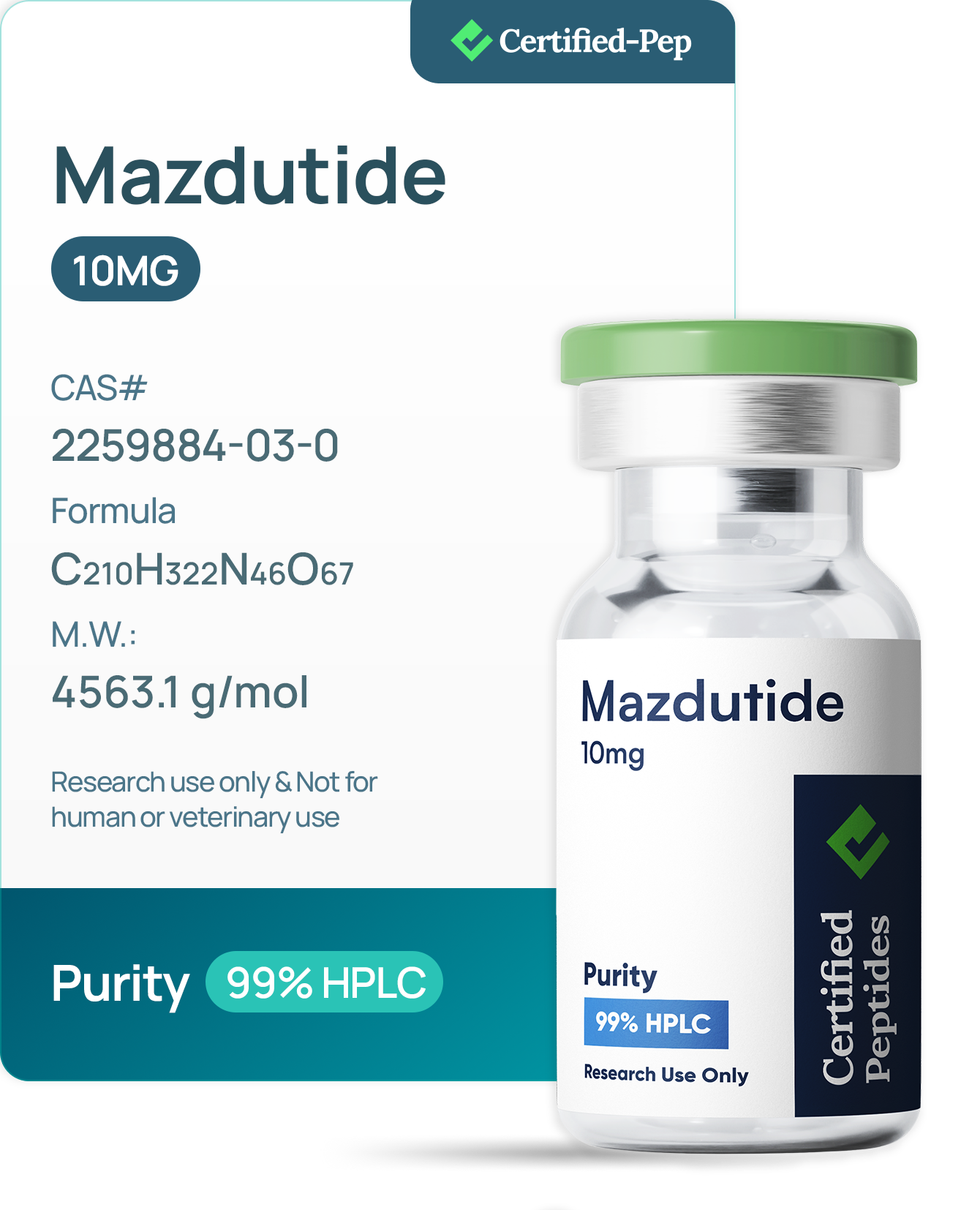
  • MAZDUTIDE 10MG from Certified PeptidesBest $/mg
    Certified PeptidesTested

    MAZDUTIDE 10MG

    $128.00

    $12.80/mg · 10mg

    Shop on Certified Peptides
  • Mazdutide – 6mg ***DISCONTINUED***– Available only while supplies last! from Solution Peptides
    Solution PeptidesTested

    Mazdutide – 6mg ***DISCONTINUED***– Available only while supplies last!

    $80.00

    $13.33/mg · 6mg

    EVERYDAY15
    Shop on Solution Peptides
  • Mazdutide from RUO
    RUO

    Mazdutide

    $28.00

    — ·

    Shop on RUO

Evidence level

Preclinical only

A synthetic dual GLP-1 and glucagon receptor co-agonist (IBI362, LY3305677) in late-stage clinical development for obesity and type 2 diabetes. Substantial human trial data, especially from Chinese phase III programs; not yet globally approved.

Mechanism

Mechanism not yet documented.

Researched benefits

  • Weight loss

    Phase II and phase III trials in adults with obesity report mean weight loss of 10–18% at 24–48 weeks at the higher dose ranges (6–9 mg weekly), comparable to semaglutide and approaching tirzepatide in some readouts. Most data is from Chinese cohorts.

  • Glycemic control

    GLP-1 agonism drives glucose-dependent insulin secretion and reduces HbA1c by 1.5–2.0% in T2D trials at therapeutic doses, with low intrinsic hypoglycemia risk.

  • Hepatic fat reduction

    The glucagon-receptor component adds direct effects on hepatic lipid metabolism. Trials in MASLD/MASH show substantial reductions in liver fat fraction beyond what pure GLP-1 agonists achieve.

  • Energy expenditure

    Glucagon agonism increases resting energy expenditure modestly, contributing to the weight-loss profile through both reduced intake and increased output.

Risks & cautions

  • moderate

    GI side effects

    Nausea, vomiting, diarrhea, and constipation are common, particularly during dose escalation. The pattern is typical of GLP-1 class drugs. Discontinuation rates in trials are similar to semaglutide.

  • moderate

    Glucagon-receptor metabolic effects

    Pure GCGR agonism raises blood glucose. The balance with GLP-1 keeps net glycemic effect favorable, but at higher doses or in individuals with hepatic disease, the glucagon component can produce undesirable lipolytic or glucose effects.

  • moderate

    Pancreatitis and gallbladder events

    Class effects of GLP-1 agonists include acute pancreatitis and cholelithiasis. Pre-marketing trials have detected the same signals for Mazdutide.

  • low

    Thyroid C-cell concern

    Rodent thyroid C-cell hyperplasia is a class concern for long-acting GLP-1 agonists. Personal or family history of MTC or MEN2 is a contraindication consistent with the class.

  • high

    Counterfeit and gray-market sourcing

    Mazdutide is not approved in the US or EU. Material sold under this name outside formal supply chains has unverified identity, purity, and dosing.

Dosing

Trial dosing is weekly subcutaneous injection with stepwise escalation. Maintenance doses studied range 3 mg, 4.5 mg, 6 mg, and 9 mg weekly depending on the indication.

Conservative
3 mg weekly maintenance after escalation
Standard
6 mg weekly maintenance
Aggressive
9 mg weekly (obesity, with prior tolerance)

Vial sizes

--

Half-life

--

Route

--

Escalation matters — starting at the maintenance dose produces severe GI side effects. Standard protocols titrate every 4 weeks. The drug is long-acting (weekly dosing) and stable in solution under refrigeration.

Contraindications

  • Personal or family history of medullary thyroid carcinoma or MEN2
  • History of pancreatitis
  • Severe hepatic impairment (glucagon component)
  • Pregnancy or breastfeeding
  • Type 1 diabetes (not studied)

In depth

Background

Mazdutide originated as a dual incretin agonist program at Eli Lilly (LY3305677) and was licensed to Innovent Biologics for development in China, where it goes by IBI362. It is structurally an oxyntomodulin analog — designed to engage both GLP-1 and glucagon receptors with a tunable ratio (Mazdutide is GLP-1-leaning, roughly 8:1 GLP-1:GCGR potency).

The drug is in late-stage trials and has been approved in China for obesity (2025). It is not approved in the US or EU as of writing. The relevance to this catalog is that Mazdutide is increasingly available through gray-market peptide channels alongside semaglutide and tirzepatide.

Mechanism in depth

Two receptors, one molecule:

  1. GLP-1 receptor agonism drives glucose-dependent insulin release, suppresses glucagon, slows gastric emptying, and produces central satiety signaling. This is the dominant weight-loss mechanism.
  2. Glucagon receptor agonism raises hepatic energy expenditure, mobilizes liver fat, and modestly increases resting metabolic rate. It also tends to raise glucose, but the GLP-1 component overrides this in net.

The therapeutic rationale for the dual agonism is that glucagon's metabolic effects compound GLP-1's appetite suppression — particularly for hepatic fat reduction, where pure GLP-1 agonists are less effective. Tirzepatide adds GIP rather than glucagon; Survodutide and Mazdutide are the leading GLP-1/GCGR examples.

Human evidence

Substantial and growing:

  • Ji 2023 phase II in 248 Chinese adults with obesity showed 11–14% weight loss at 24 weeks across dose levels.
  • Phase III GLORY-1 reported similar magnitudes in larger cohorts.
  • T2D trials show HbA1c reductions consistent with class expectations.
  • MASLD trials report liver fat fraction reductions of 60–80% at therapeutic doses.

Western trial data is more limited; the bulk of clinical evidence is Chinese.

Animal evidence

Robust in DIO mice, obese non-human primates, and rat models of MASH. Pharmacology is well-characterized at both receptors.

Stack synergy

Generally not stacked with other incretin agonists — overlapping mechanism is redundant and amplifies GI side effects. Anecdotal pairings:

  • 5-Amino-1MQ — for lean-mass preservation during incretin-driven weight loss (rationale, not evidence).
  • BPC-157 — for GI tolerance during escalation (anecdotal).
  • Tesamorelin — to support GH/IGF-1 axis during weight loss; modest theoretical synergy.

Avoid combining with sulfonylureas or insulin without dose adjustment — hypoglycemia risk rises.

Open questions

  • How does Mazdutide compare head-to-head with tirzepatide for weight loss? No direct comparison trial has reported.
  • Are the hepatic fat reductions durable, or do they rebound on discontinuation as appetite returns?
  • What is the optimal GLP-1:GCGR ratio for different indications? Mazdutide's 8:1 may not be optimal for MASH versus obesity.
  • Long-term cardiovascular and cancer outcomes await large outcome trials.
References

  1. 1.Ji L. et al. — A phase 2 trial of mazdutide in Chinese adults with obesity (Nat Commun, 2023)
  2. 2.Innovent Biologics / Eli Lilly — Mazdutide clinical development program publications (multiple, 2022–2025)
  3. 3.Henderson S.J. et al. — Robust anti-obesity and metabolic effects of a dual GLP-1/glucagon receptor peptide agonist in rodents and non-human primates (Diabetes Obes Metab, 2016)

Everyday Peptides

Independent peptide guides and vendor comparison. Research-grade information for adult researchers.

Browse

  • All peptides
  • All vendors

About

  • About us
  • Contact

Legal

  • Affiliate disclosure
  • Privacy

(c) 2026 Everyday Peptides. Some links on this site are affiliate links. We may earn a commission when you purchase through them, at no extra cost to you.

All content is for educational purposes only and is not medical advice. Peptides discussed are for research use only.