Skip to content
Save at BioLongevity Labs with code EVERYDAY•Save at S1 Research with code everydaypeptide•Save at Alpha Peptides with code EVERYDAY•Save at Ion Peptide with code EVERYDAY•Save at Solution Peptides with code EVERYDAY15•Save at Atomik Labz with code EVERYDAY25•Save at Next Gen Peps with code EVERYDAY•
EVERYDAYPEPTIDES
  • Peptides
  • Vendors
  1. Home
  2. Peptides
  3. PT-141

Sexual Health

PT-141

Bremelanotide

A melanocortin receptor agonist used for hypoactive sexual desire disorder in premenopausal women.

Phase IIIResearch use only

About PT-141

PT-141 (bremelanotide) is a synthetic peptide that acts on the central melanocortin system to influence sexual arousal. Approved as Vyleesi for HSDD in premenopausal women; widely studied off-label.

Category
Sexual Health
Typical dose
0.5-2 mg pre-event
Vial sizes
10mg
Half-life
~2 hours
Administration
subcutaneous
Goals
Sexual health

Where to buy

Vendor offerings

Some links on this page are affiliate links. We may earn a commission when you purchase through them, at no extra cost to you.

  • PT-141 10mg from RUOBest $/mg
    RUO

    PT-141 10mg

    $36.00

    $3.60/mg · 10mg

    Shop on RUO
  • PT-141 – 10mg from Atomik Labz
    Atomik LabzTested

    PT-141 – 10mg

    $37.00

    $3.70/mg · 10mg

    EVERYDAY25
    Shop on Atomik Labz
  • PT-141 – 10mg from Ion Peptide
    Ion PeptideTested

    PT-141 – 10mg

    $37.00

    $3.70/mg · 10mg

    EVERYDAY
    Shop on Ion Peptide
  • PT-141 – 10mg from Solution Peptides
    Solution PeptidesTested

    PT-141 – 10mg

    $37.00

    $3.70/mg · 10mg

    EVERYDAY15
    Shop on Solution Peptides
  • Drops – PT-141 | 30mg from Ion Peptide
    Ion PeptideTested

    Drops – PT-141 | 30mg

    $139.00

    $4.63/mg · 30mg

    EVERYDAY
    Shop on Ion Peptide
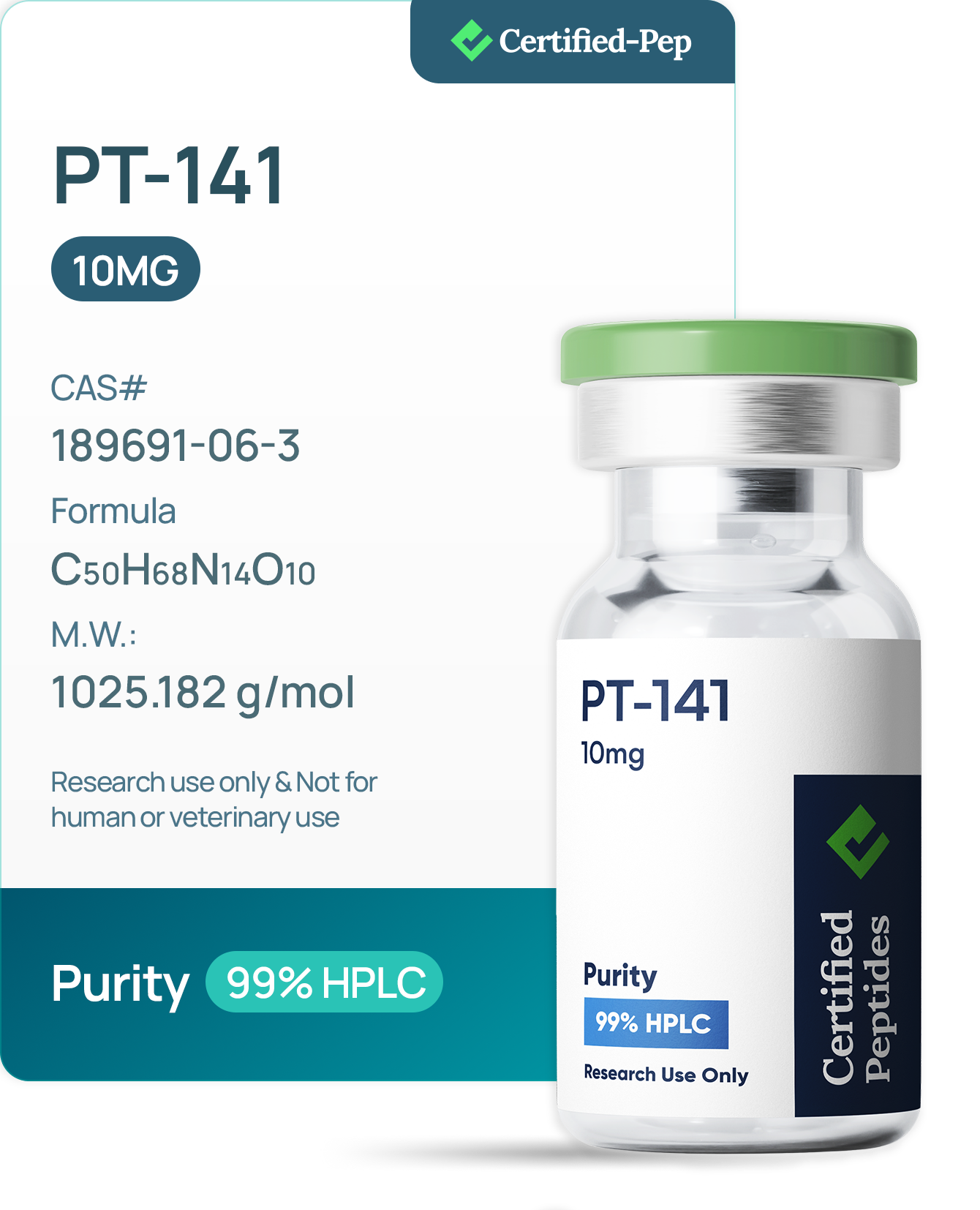
  • PT 141 10MG from Certified Peptides
    Certified PeptidesTested

    PT 141 10MG

    $58.00

    $5.80/mg · 10mg

    Shop on Certified Peptides
  • PT-141 10mg from S1 Research
    S1 ResearchTested

    PT-141 10mg

    $60.00

    $6.00/mg · 10mg

    everydaypeptide
    Shop on S1 Research
  • PT-141 (5mg) from BioLongevity Labs
    BioLongevity LabsTested

    PT-141 (5mg)

    $47.97

    $9.59/mg · 5mg

    EVERYDAY
    Shop on BioLongevity Labs
  • PT-141 from Alpha Peptides
    Alpha PeptidesTested

    PT-141

    $22.70

    — ·

    EVERYDAY
    Shop on Alpha Peptides
  • PT-141 from Next Gen Peps
    Next Gen PepsTested

    PT-141

    $54.00

    — ·

    EVERYDAY
    Shop on Next Gen Peps

Evidence level

Phase 3 trials

A synthetic melanocortin receptor agonist (bremelanotide) approved as Vyleesi for hypoactive sexual desire disorder in premenopausal women. Acts centrally on MC3R/MC4R rather than peripherally on vasculature.

Mechanism

Activates melanocortin receptors (MC3R, MC4R) in the CNS.

Researched benefits

  • Centrally-mediated sexual arousal

    Activates MC4R in the hypothalamus, producing arousal that is upstream of vascular effects. Mechanism is distinct from PDE5 inhibitors (sildenafil, tadalafil) and works in users for whom PDE5 inhibitors are insufficient.

  • Approved for HSDD

    Phase 3 RECONNECT trials (n≈1247) demonstrated improvement in desire and reduction in distress scores vs placebo. Approved as Vyleesi (1.75 mg auto-injector, on-demand) for premenopausal HSDD in 2019.

  • Works in both sexes

    Off-label use in men with erectile dysfunction predates the Vyleesi approval; the central mechanism produces arousal-supporting effects independent of sex. Effect sizes in men were smaller in trials and did not lead to a male indication.

  • On-demand pharmacokinetics

    Onset within 45 minutes; effect window ~2–4 hours. Does not require chronic dosing.

Risks & cautions

  • moderate

    Transient hypertension

    A reproducible 6/3 mmHg average rise in systolic/diastolic BP appears in the hour after dosing, returning to baseline within 12 hours. Labeled contraindication in uncontrolled hypertension or cardiovascular disease.

  • moderate

    Nausea

    Most common adverse effect — ~40% of users in trials, severe enough to discontinue in ~8%. Often improves with subsequent doses but a non-trivial minority cannot tolerate the compound.

  • moderate

    Focal hyperpigmentation

    MC1R cross-activity drives melanocyte stimulation. Darkening of the face, gums, or breasts occurs with repeated use — reversibility is partial. More common with frequent dosing.

  • low

    Headache and flushing

    Common, generally mild, mostly self-limited within hours of dosing.

Dosing

0.5–2 mg subcutaneously, 30–45 minutes before anticipated sexual activity. Vyleesi formulation is 1.75 mg auto-injector.

Conservative
0.5–1 mg pre-event
Standard
1.75 mg (Vyleesi) pre-event
Aggressive
2 mg pre-event

Vial sizes

10mg

Half-life

~2 hours

Route

subcutaneous

Label limit is one dose per 24 hours and ≤8 per month — both nausea and hyperpigmentation are dose-dependent. Reconstitution of research powder requires bacteriostatic water; concentration accuracy matters at sub-milligram doses.

Contraindications

  • Uncontrolled hypertension
  • Cardiovascular disease (ischemic, structural)
  • Pregnancy
  • Concurrent oral naltrexone (reduces naltrexone exposure)

In depth

Background

PT-141 (bremelanotide) is a synthetic cyclic heptapeptide derived from α-melanocyte-stimulating hormone (α-MSH). It was originally developed as an offshoot of melanotan-II research — early melanotan-II trials in the 1990s noticed unexpected sexual side effects, which led Palatin Technologies to design a derivative optimized for that effect rather than for tanning.

Bremelanotide received regulatory approval in 2019 as Vyleesi for hypoactive sexual desire disorder (HSDD) in premenopausal women. It is the second approved drug for HSDD (after flibanserin), and the only one in the melanocortin class.

Mechanism in depth

PT-141 is a non-selective melanocortin receptor agonist with activity at MC1R, MC3R, MC4R, and MC5R. The clinically relevant receptors for sexual effects are:

  1. MC4R in the hypothalamus. MC4R signaling in the paraventricular nucleus and medial preoptic area drives sexual arousal pathways. This is the principal target.
  2. MC3R contributes to autonomic and behavioral integration.
  3. MC1R (melanocyte) drives the hyperpigmentation side effect — clinically unwanted but unavoidable with the current pharmacophore.

The central mechanism distinguishes PT-141 from sildenafil-class drugs, which act peripherally on vascular smooth muscle. PT-141 generates desire and arousal upstream of vascular response — clinically useful when arousal itself is the deficit, not erectile mechanics.

Human evidence

The clinical dataset is substantial:

  • RECONNECT 1 & 2 (n≈1247 combined) — pivotal phase 3 trials in premenopausal HSDD. Bremelanotide 1.75 mg pre-event produced statistically significant improvement in desire score (FSFI-D) and reduction in associated distress (FSDS-DAO) vs placebo.
  • Early phase 2 work in male ED (n≈350) showed efficacy but smaller effect size; the male program was deprioritized in favor of the female HSDD path.
  • Post-marketing experience has confirmed the side-effect profile (nausea, transient BP, hyperpigmentation) and the contraindication in cardiovascular disease.

Preclinical evidence

Rodent models of female sexual behavior (proceptive behaviors, lordosis) showed reproducible enhancement with bremelanotide. Male rat erection models also responded. The mechanism was traced to specific MC4R-expressing neuron populations using receptor knockout and pharmacological dissection.

Stack synergy

PT-141 is most commonly used as a standalone on-demand agent. Practical considerations when combining:

  • PDE5 inhibitors (sildenafil, tadalafil) — mechanism is non-overlapping (central vs vascular). Combination is sometimes used in ED that is partly desire-driven, partly vascular. Cardiovascular risk additivity should be considered, especially given PT-141's transient BP rise.
  • Oxytocin — sometimes paired anecdotally; no formal interaction data.
  • Kisspeptin — mechanistically interesting (both modulate central reproductive circuits) but the combination is unstudied.

Avoid with stimulants, MAOIs, or strong sympathomimetics — the additive cardiovascular load is poorly characterized.

Open questions

  • Does the hyperpigmentation reverse fully with discontinuation, or is some change permanent? Patient reports vary; no rigorous longitudinal data.
  • Is there a more selective MC4R agonist that retains efficacy without MC1R-driven pigmentation? Setmelanotide (MC4R-selective, approved for obesity) demonstrates the receptor is druggable in isolation — but a sexual-function indication for a selective MC4R agonist has not been pursued.
  • What is the long-term safety beyond ~8 doses per month? The label restricts frequency; data above that is sparse.
  • How does central arousal interact with relationship and psychological context? Trials measured pharmacological effect; real-world effectiveness depends heavily on context.

References

  1. 1.Kingsberg S.A. et al. — Bremelanotide for the treatment of hypoactive sexual desire disorder: RECONNECT trials (Obstetrics & Gynecology, 2019)
  2. 2.Clayton A.H. et al. — Bremelanotide for female sexual dysfunctions in premenopausal women (Womens Health, 2016)
  3. 3.Prescribing information — Vyleesi (bremelanotide injection)

Everyday Peptides

Independent peptide guides and vendor comparison. Research-grade information for adult researchers.

Browse

  • All peptides
  • All vendors

About

  • About us
  • Contact

Legal

  • Affiliate disclosure
  • Privacy

(c) 2026 Everyday Peptides. Some links on this site are affiliate links. We may earn a commission when you purchase through them, at no extra cost to you.

All content is for educational purposes only and is not medical advice. Peptides discussed are for research use only.