Skip to content
Save at BioLongevity Labs with code EVERYDAY•Save at S1 Research with code everydaypeptide•Save at Alpha Peptides with code EVERYDAY•Save at Ion Peptide with code EVERYDAY•Save at Solution Peptides with code EVERYDAY15•Save at Atomik Labz with code EVERYDAY25•Save at Next Gen Peps with code EVERYDAY•
EVERYDAYPEPTIDES
  • Peptides
  • Vendors
  1. Home
  2. Peptides
  3. Thymosin Alpha-1

Immune

Thymosin Alpha-1

Immune Modulating Peptide

A 28-amino-acid peptide studied for immune modulation in chronic infection and recovery.

Phase IIIResearch use only

About Thymosin Alpha-1

Thymosin Alpha-1 is a 28-amino-acid peptide derived from the prothymosin alpha precursor. Approved in some countries as Zadaxin for hepatitis B and C; widely studied for immune modulation in chronic infection, sepsis, and recovery from immunosuppression.

Category
Immune
Typical dose
1.6 mg subcutaneous, 2x weekly
Vial sizes
5mg / 10mg
Half-life
~2 hours
Administration
subcutaneous
Goals
immune, Recovery

Where to buy

Vendor offerings

Some links on this page are affiliate links. We may earn a commission when you purchase through them, at no extra cost to you.

  • Thymosin Alpha-1 5mg (COA in Progress) from RUOBest $/mg
    RUO

    Thymosin Alpha-1 5mg (COA in Progress)

    $32.00

    $6.40/mg · 5mg

    Shop on RUO
  • Thymosin Alpha 1 – 10mg from Atomik Labz
    Atomik LabzTested

    Thymosin Alpha 1 – 10mg

    $65.00

    $6.50/mg · 10mg

    EVERYDAY25
    Shop on Atomik Labz
  • Thymosin Alpha 1 – 10mg from Solution Peptides
    Solution PeptidesTested

    Thymosin Alpha 1 – 10mg

    $65.00

    $6.50/mg · 10mg

    EVERYDAY15
    Shop on Solution Peptides
  • Thymosin Alpha 1 – 10mg from S1 Research
    S1 ResearchTested

    Thymosin Alpha 1 – 10mg

    $75.00

    $7.50/mg · 10mg

    everydaypeptide
    Shop on S1 Research
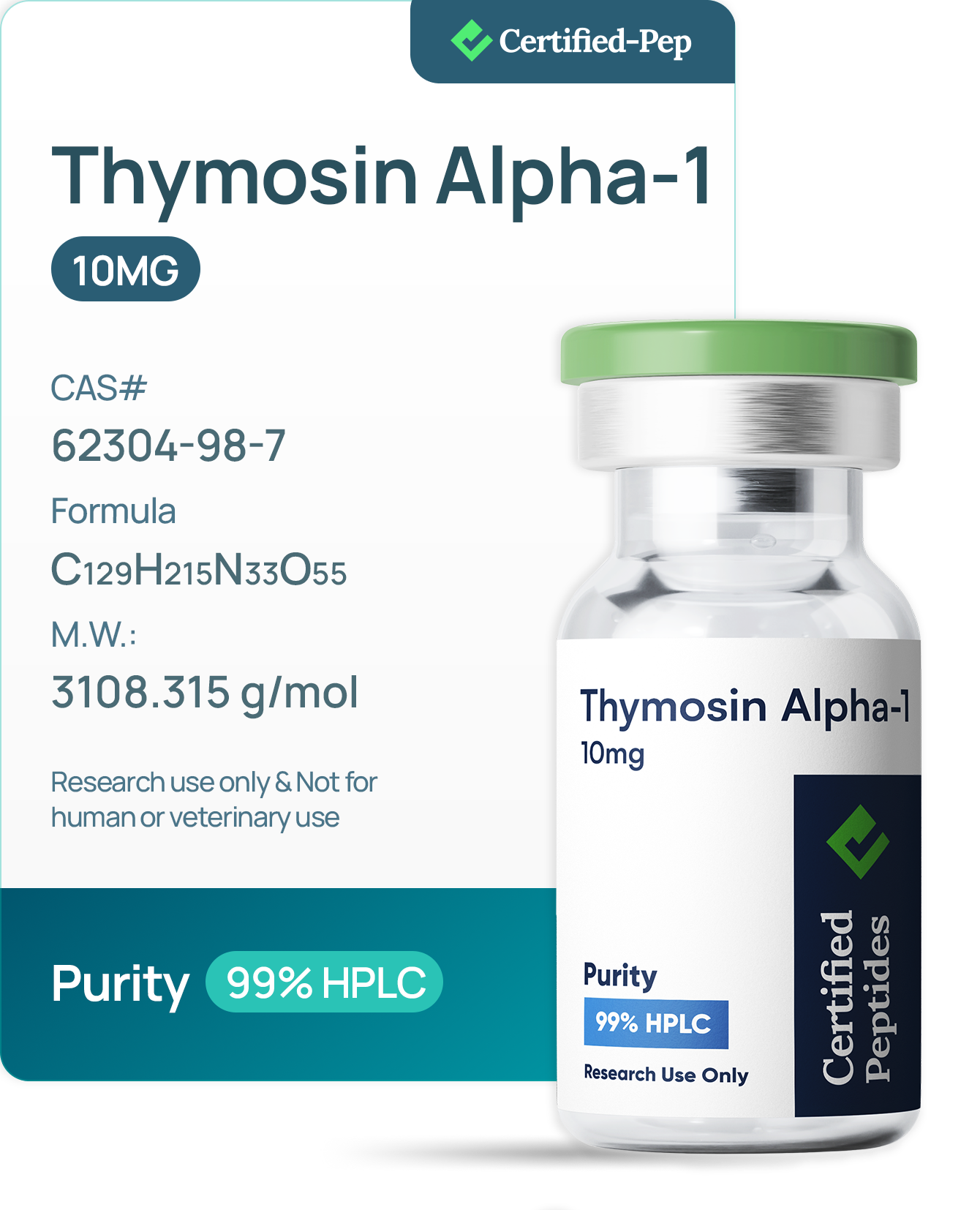
  • THYMOSIN ALPHA-1 10MG from Certified Peptides
    Certified PeptidesTested

    THYMOSIN ALPHA-1 10MG

    $78.00

    $7.80/mg · 10mg

    Shop on Certified Peptides
  • Thymosin Alpha 1 (10mg) from BioLongevity Labs
    BioLongevity LabsTested

    Thymosin Alpha 1 (10mg)

    $129.97

    $13.00/mg · 10mg

    EVERYDAY
    Shop on BioLongevity Labs
  • Thymosin Alpha-1 from Ion Peptide
    Ion PeptideTested

    Thymosin Alpha-1

    $65.00

    — ·

    EVERYDAY
    Shop on Ion Peptide
  • Thymosin Alpha 1 (Tα1) from Peptira
    PeptiraTested

    Thymosin Alpha 1 (Tα1)

    $59.00

    — ·

    Shop on Peptira

Evidence level

Phase 3 trials

A 28-amino-acid immunomodulatory peptide derived from prothymosin alpha. Approved as Zadaxin in 30+ countries for hepatitis B/C and as a vaccine adjuvant. Substantial clinical evidence base; modulates T-cell maturation and dendritic cell function.

Mechanism

Stimulates T-cell maturation and modulates innate and adaptive immunity.

Researched benefits

  • T-cell maturation and function

    Promotes maturation of thymocytes into functional T cells, restores Th1 responses, and increases CD4/CD8 T-cell counts in immunocompromised patients. Mechanism is well characterized through TLR signaling on dendritic cells.

  • Adjunct to antiviral therapy in chronic hepatitis

    Approved in Italy, China, and elsewhere for chronic hepatitis B and C in combination with interferon. Meta-analyses show modest improvement in sustained virologic response.

  • Sepsis mortality reduction (early trial signal)

    The ETASS trial in Chinese ICU patients (n=361) reported lower 28-day mortality with thymosin alpha-1 in severe sepsis. Larger replication trials are ongoing or completed with mixed signals.

  • Vaccine adjuvant effect

    Enhances antibody response to influenza and hepatitis B vaccines in elderly or immunocompromised patients in multiple controlled trials.

  • Cancer adjunct (investigational)

    Studied as immunostimulant adjunct in hepatocellular carcinoma, melanoma, and lung cancer. Results are mixed and it is not standard of care.

Risks & cautions

  • moderate

    Autoimmune flare

    Theoretical and occasionally reported: by augmenting T-cell responses, TA1 could worsen active autoimmune disease. Avoid in flares of lupus, RA, MS, or active IBD.

  • low

    Injection-site reactions

    Erythema and transient discomfort at SC injection site are the most common adverse events in clinical trials.

  • high

    Transplant immunology

    Contraindicated in organ transplant recipients on immunosuppression — direct pharmacologic opposition.

  • moderate

    Limited data in pregnancy

    No controlled pregnancy data. Animal data suggests low teratogenic risk but human data is absent.

Dosing

1.6 mg subcutaneously, twice weekly. Hepatitis protocols often use this dose for 6–12 months.

Conservative
0.8 mg × 2/week
Standard
1.6 mg × 2/week (Zadaxin labeling)
Aggressive
1.6 mg daily (short ICU sepsis protocols only)

Vial sizes

5mg / 10mg

Half-life

~2 hours

Route

subcutaneous

Reconstitute lyophilized powder with sterile water (typically provided diluent for the licensed product). Plasma half-life ~2 hours but immunomodulatory effects persist for days. Generally well tolerated for courses of 6–12 months.

Contraindications

  • Solid organ transplant recipients on immunosuppression
  • Active autoimmune disease flare
  • Known hypersensitivity to thymosin
  • Pregnancy and breastfeeding (precautionary)

In depth

Background

Thymosin alpha-1 (TA1) was isolated and sequenced by Allan Goldstein at the Albert Sackler School of Medicine in the 1970s from bovine thymic extract (thymosin fraction 5). It is a 28-amino-acid, acidic, N-acetylated peptide produced naturally as a cleavage product of prothymosin alpha. SciClone Pharmaceuticals brought the synthetic version to market as Zadaxin, which is licensed in over 30 countries (Italy, China, much of Latin America and Asia) for chronic hepatitis B and C, as a vaccine adjuvant, and as adjunctive therapy in some cancers. It is not approved in the U.S. but has been used compassionately and in trials.

This is one of the most clinically validated peptides in the "research peptide" market.

Mechanism in depth

Thymosin alpha-1 works primarily by modulating the immune system at multiple checkpoints:

  1. Dendritic cell activation via TLR9 — TA1 signals through Toll-like receptor 9 on plasmacytoid dendritic cells, biasing immune responses toward Th1.
  2. T-cell maturation — Restores thymocyte differentiation into functional CD4+ and CD8+ T cells; particularly relevant in thymic involution and immune aging.
  3. NK cell enhancement — Increases natural killer cell cytotoxicity, contributing to antiviral and antitumor effects.
  4. Cytokine modulation — Increases IL-2, IFN-γ, IL-12; decreases IL-10 in dysregulated states. Net effect is restoration of balanced Th1/Th2 signaling rather than blanket immune stimulation.

The most clinically relevant property is that TA1 restores dysfunctional immune responses (anergic or exhausted T cells, suppressed sepsis-induced immunoparalysis) rather than hyperstimulating normal ones.

Human evidence

Among the strongest evidence bases for any research peptide:

  • Hepatitis B/C: Multiple RCTs and meta-analyses (Liu 2014 and others) support modest benefit when combined with interferon-based regimens. The effect size is smaller than direct-acting antivirals but TA1 was useful before DAAs existed.
  • Sepsis: The ETASS trial (Wu 2013, n=361) reported a reduction in 28-day mortality. Subsequent trials including the larger TESTS trial have shown mixed results.
  • COVID-19: Multiple observational studies during the pandemic suggested benefit in severe COVID, particularly in lymphopenic patients. RCT evidence was limited and inconclusive.
  • Vaccine adjuvant: Increases seroconversion to hepatitis B and influenza vaccines in hemodialysis patients and elderly populations.
  • Cancer immunotherapy adjunct: Mixed phase II data in melanoma, HCC, and lung cancer.

Animal evidence

Decades of rodent and primate data establish T-cell restoration, antiviral activity (HBV, CMV, influenza models), and tumor immunity effects. Animal models predicted the clinical efficacy in viral hepatitis.

Stack synergy

  • Thymosin beta-4 (TB-500) — different mechanism (actin-binding, tissue repair); commonly co-administered for combined immune + recovery support, though no formal interaction data.
  • BPC-157 — different pathway; combined with TA1 in some "recovery + immune" stacks.
  • LL-37 — both have antimicrobial / immunomodulatory activity; theoretical complementarity, no combined-use data.
  • Interferon-α — clinically combined in hepatitis protocols.
  • Avoid with concurrent immunosuppressants (tacrolimus, cyclosporine, anti-TNF biologics) — direct opposition.

Open questions

  • Does TA1 reduce mortality in severe sepsis? Trial signals are inconsistent and the question is unresolved.
  • What is the optimal duration of therapy in non-hepatitis indications? Most protocols are 6 months by convention rather than evidence.
  • Could TA1 have a role in immune aging or vaccine response in healthy older adults? Plausible but understudied.
  • Is the "research grade" supply sufficiently equivalent to pharmaceutical Zadaxin to extrapolate efficacy claims?

References

  1. 1.Goldstein A.L., Badamchian M. — Thymosins: chemistry and biological properties in health and disease (Expert Opin Biol Ther, 2004)
  2. 2.Wu J. et al. — The efficacy of thymosin alpha 1 for severe sepsis (ETASS): a multicenter, single-blind, randomized and controlled trial (Crit Care, 2013)
  3. 3.Romani L. et al. — Thymosin alpha 1: an endogenous regulator of inflammation, immunity, and tolerance (Ann N Y Acad Sci, 2007)
  4. 4.Liu Y. et al. — Efficacy of thymosin α1 in the treatment of chronic hepatitis B virus infection: a meta-analysis (Antivir Ther, 2014)

Everyday Peptides

Independent peptide guides and vendor comparison. Research-grade information for adult researchers.

Browse

  • All peptides
  • All vendors

About

  • About us
  • Contact

Legal

  • Affiliate disclosure
  • Privacy

(c) 2026 Everyday Peptides. Some links on this site are affiliate links. We may earn a commission when you purchase through them, at no extra cost to you.

All content is for educational purposes only and is not medical advice. Peptides discussed are for research use only.